New World vs Old World
Occasioned by once again being in South Africa and marvelling at the wealth of old vines populating her wine lands I’m drawn back to the contentious subject of Old World vs. New World as a descriptor for wines.
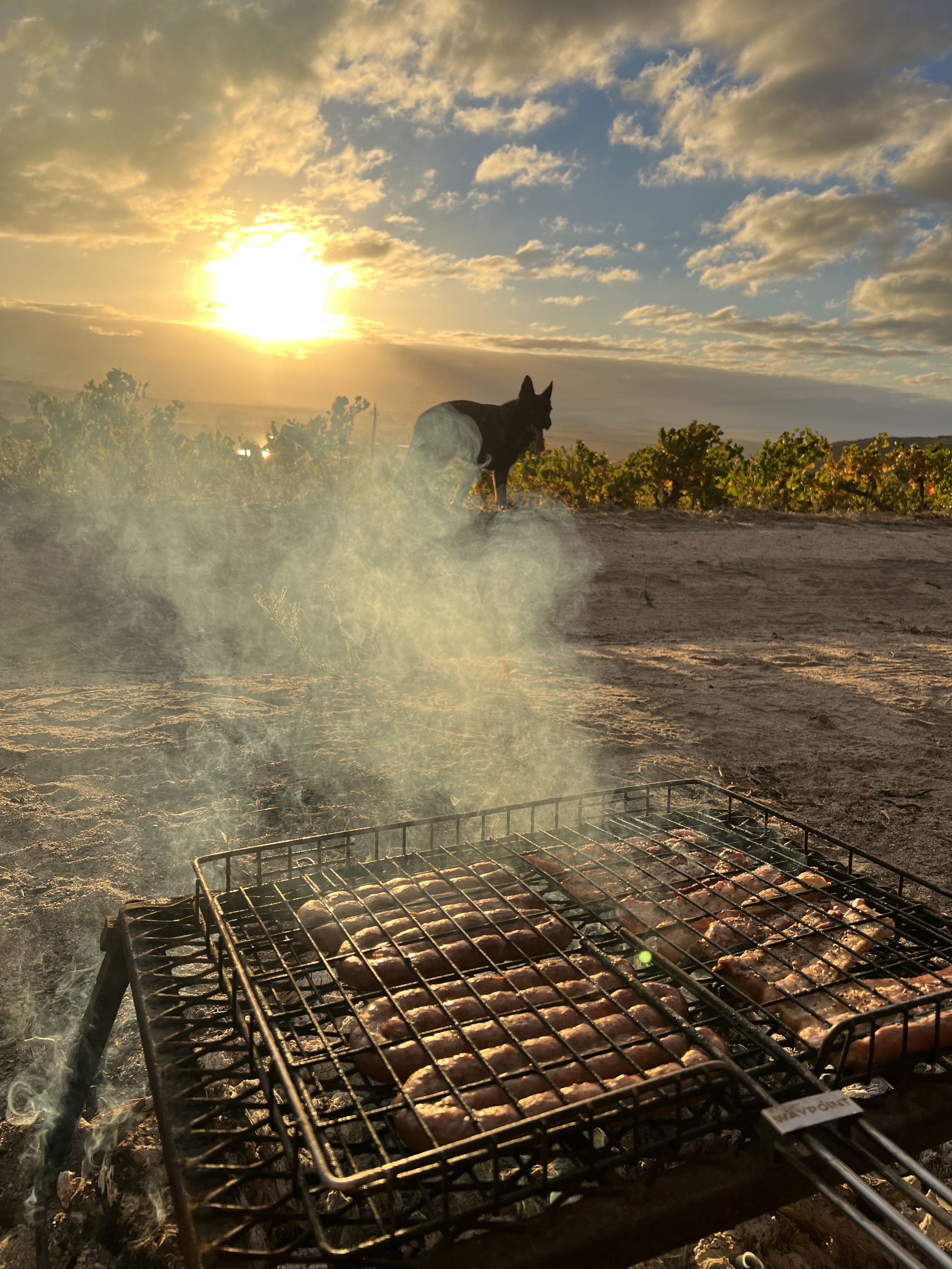
Morning braai at Kalmersfontein
One of my closest and best friends would castigate me terribly for this as she cannot abide the phrase, regularly reminding me of both the age of discovery colonial era origins of the term and, more geographically, the fact that here in South Africa, the wine industry dates back to the 1650s, which, while young compared the the Staffelter Hofs and Bourdy’s of the world is more than old enough to be considered properly old.
The annoying thing about the old/new distinction is that very often it’s incredibly useful in terms of starting to identify where a wine comes from. A certain fruit sweetness here, the hum of a bit of Brett there and we all know which way we’re going when asked.
So, I’m proposing a continued usage of the descriptor (I usually lose the suffix ‘world’, a little like terra nullis, it stinks of ownership claims, genocide and slavery) new / old, the underlying rationale may seem, initially a tad complex, I think it’s actually gives a sense of utility back to something we feel is instinctively useful and true.
Wine making, as best we know dates back some 6000 years, its spread by the Phoenicians, then Greeks, then Romans ensured that the best part of temperate Europe was, to some degree, farming vines. This gave the various vinifera sub-species more than enough time to split and become embedded in the fabric of local agricultural life. Throw in the myriad local traditions and cultures whose labour made the wines and we have a recipe for a staggering multiplicity of styles. This is what, with a hat tip to Aaron Ayscough, through whom I was first introduced to this idea, I’m calling the pre-industrial traditional style; or as you will, Old World.
The crux of this, is that the interplay between grape variety, place and people has had multiple hundreds of years to co-evolve, all without the kind of centralised choice of clone and methodology that arrives post phylloxera with the great vine libraries, agricultural colleges and clonal selection / propagation programs. Now, none of the above are a-priori bad, indeed, much of what they did served to right some major methodological wrongs. Indeed, we’re much better off now that our winemakers understand the technicalities of their craft. The wines of Chianti are now once again the pride of Tuscany, having been rescued from their industrial jug wine nadir of the 1980s by a concerted program of selection and propagation of Sangiovese clones that yielded lower and gave better wines.
The opening up of the world to wines being traded far and wide across borders, along with the scattering of European settlers to the Americas, South Africa and Australasia has spread wine farming across to world to pretty much every corner where it’s temperamentally suited.
Here we have another subtlety. It’s not the scattering of peoples that makes the wine New World.
The early Spanish settlers in South America brought with them vines to plant to make communion wines, half a millennia later these Criollo vines are their own unique family, one that shares a thrilling lineage with the only recently-rediscovered wines of the Atlantic islands, their familial relationships a genetic map of the routes of conquest. The brilliant Criollo wines of Argentina, Chile and in particular the 200-plus year old tree trained vineyards of the Cinti Valley in Bolivia and resolutely Old World, their scattershot diversity a feature of myriad generations of farmers studying their own particular plots, of struggle, local selection and the isolating distance between valleys in a world without roads and cars.
The Dutch arrived in South Africa with grapes to make their beloved Brandies and fortified wines, Muscat de Frontignan and Chenin, chief amongst them. The Cape was on the maritime route East a major stop-over point for trade. As such the fame of Cape Brandies and the Iconic Constantia spread far and wide. The Cape Dutch, capable farmers that they were took their plantings and spread them across what would be the Cape Wine Lands. Farmers bequesting their best cuttings to children and neighbours as they left to carve lives for themselves in valleys new. All the while the relentless South African sun baked the varieties into something new. The old bush vine Chenins of the Swartland now vastly different to their Loire dwelling brethren. So much so that in response to our man-made climate crisis, the French are now looking to the Cape for Chenin clones with better heat and drought resistance. Furthermore, anyone tasting the best of the Cape Chenins and old-vine blends will struggle to see their brilliance and uniqueness of style, wines born of place and generations of winemaking tradition.
The very first Italian and German immigrants to California and Australia brought with them less cuttings and more a folk memory of wine culture. It’s here that our story somewhat changes as the vine stock they built their new lives around was brought over by people who’d travelled around Europe collecting the best of the great classic regions’ varieties; James’ Busby and Colcannon and their ilk. We start now to have an element of forethought in terms of emulating the classics of the home countries.
By now we’re in the late 1800’s and the seeds of the Australian and American wine industries are being lain. It’s in this liminal space that I need to draw a little line in terms of the super old vines we find in Dry Creek and the Barossa. They’re first generation plantings. While they may be phenotypically different to their direct ancestors this is more due to epigenetic factors in their adapting to their new homes. We haven’t seen the multiple generations of massale selection that characterises for example the Cape Chenin.
The true New World style really comes about in the mid twentieth century and is the result of large industry growth across the West coast of the USA, Australia, New Zealand, Chile and Argentina. In all cases it came from the emulation of specifically French wine archetypes.
We’re several years post WW2, the German wine industry has pioneered steel tanks, cooling and sterile filtration. The world is now global on a time scale heretofore unheard of and France is the cultural lodestone. The USA is the dominant economy and the postwar generation is in thrall to writers like AJ Liebling, AF Schoonemaker and Julia Child. France, French gastronomy and her wines were the things to be aspired to. As an aside, I think we see something like the loss of genetic diversity due to a near extinction event in the way that the nascent mass media of the 2nd half of the twentieth century promulgated the idea of France and her food and wine culture.
Suddenly, if you were an industrialist with money to burn and a desire to be taken seriously, you planted vines with the idea of making the next great Bordeaux or Burgundy style wine. In retrospect, the importance of Spurrier’s 1971 Judgement of Paris wasn’t so much who won, but that all the wines the Californians were taking seriously were modelled on Red Bordeaux or White Burgundy; a pattern that would play out over the next few decades.
Here, I think, is the crux of New World wine, they’re wines that explicitly ape the archetypes of another place. Be that Cabernet and Merlot in Bolgheri, Chardonnay in the Piedemonte, Syrah in the Fruska Gora or Pinot Noir in Essex. Like pornography in the Lady Chatterly’s lover trial, one knows it when one sees it. The planting of grapes from cooler regions in places where they’re much easier to farm, the use of irrigation, the separation between grower and winemaker, all of these may form a part of the ’New World’ style, but really it’s the looking elsewhere in terms stylistic goal that is the marker.
So we have now a nice distinction, regions and wines with an existing pre-industrial stylistic history and those that are explicitly apeing those that do. I feel like this is a useful working definition.
Post script.
An interesting development in this would be the sort of terroir specific plantings in places like Tablas Creek or Brookdale; both are recreating field blend sites to more accurately ensure the vineyard is what is put across rather than any full on varietal character.
Going further down this route, we can go to Poplouchoum, South of Santa Cruz in California to see what Randall Graham is doing trying to short circuit those generations of selective pressure in creating his reading of Californian terroir.
Post post script.
I’m aware that the Medoc, of which many of the great New World reds were attempted facsimiles of, is barely pre-industrial, but that’s for another essay entirely.